Chambo Fisheries, Malawi, 2013
From microbes to fish: the new revolution in tilapia food fish production
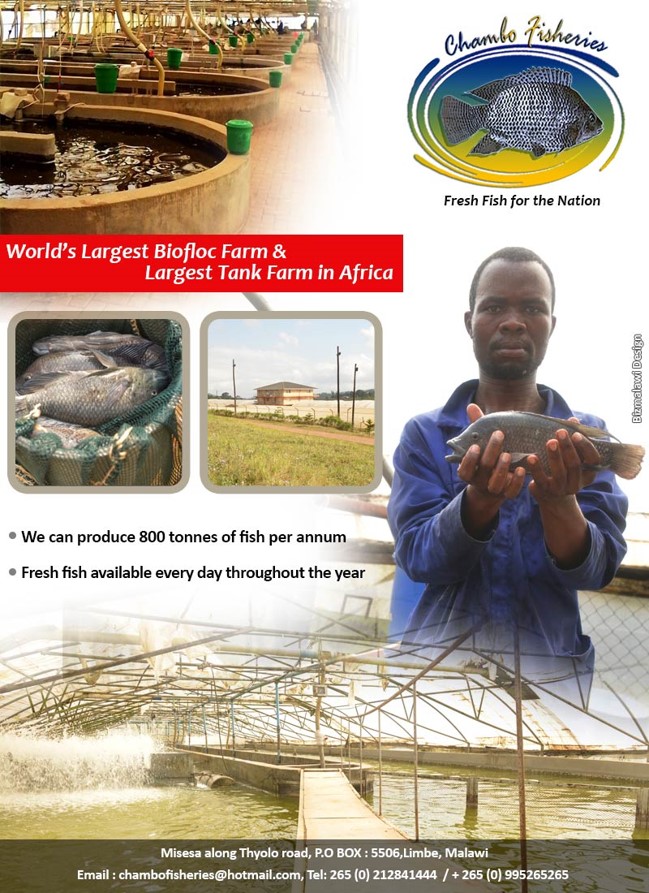
Chambo Fisheries, ranked the worlds largest and most advanced Biofloc Technology (BFT) tilapia farm, began selling fish in late 2013. Further refinements in specialised on-site feed manufacture coupled with improved management procedures increased water quality stability when the farm switched to 20.2% protein C/N ratio feeds (15.5:1) resulted in improved performance and system stability. See the full feature article published in the June 2017 issue of World Aquaculture (click here...).
Feed Conversion Ratio’s (FCR’s) averaging 1 : 1 feeding a 20.2% protein feed (equal to a C/N ratio of 15.5 : 1) raising Mozambique tilapia (Oreochromis mossambicus) and Shiranus tilapia (O. shiranus) were routinely achievable. Such huge formulated feed fed protein shortfalls means that fish are able to “find” the balance of their needed protein ranging from 55-60% of total required protein intake via filter feeding on biofloc aggregations.
These results are not surprising considering both the high protein content of 30-60% (on a DM basis) and high carbon conversion efficiency via the “heterotrophic microbial loop” of around 40-60% into heterotrophic bacterial cell biomass and the very short trophic pathway (lower trophic energy losses) of microbial aquaculture systems; Dissolved C + N → C + N in microbes → C + N in farmed organisms.
Biofloc tilapia production is then over 100% more efficient when gauged against Net Protein Retention (NPR) values of tilapia raised in a RAS system and 162% more efficient than lake cage culture. In monetary terms results at Chambo Fisheries represents a 50% feed cost saving when compared to feeding the same size class of fish on conventional 32% protein feeds raised in a RAS.
The merits of BFT are significant reducing the final farm gate production cost of raising tilapias to around US$1.30 kg-1 (about R 17.70 kg-1) in Malawi in 2016. A comprehensive economic study based upon data gathered from Chambo Fisheries shows BFT farms to potentially produce tilapia at about 60% less than large-scale cage culture, 34% less than RAS and 8.5% less than greenwater pond farming where all farms were located in- or near Lake Malawi.